


(this is a new shift, and this page is still in development)
This shift is about building practical resilience, together.
‘Resilience is relational’
It’s not something we can do on our own, but that we do as part of a part of a network.
Communities with stronger social ties experience fewer deaths, less conflict, and faster recovery. We can still live well, with lives full of meaning (indeed we may end up with more meaning and connection).
There are many things we can do to build practical resilience together…
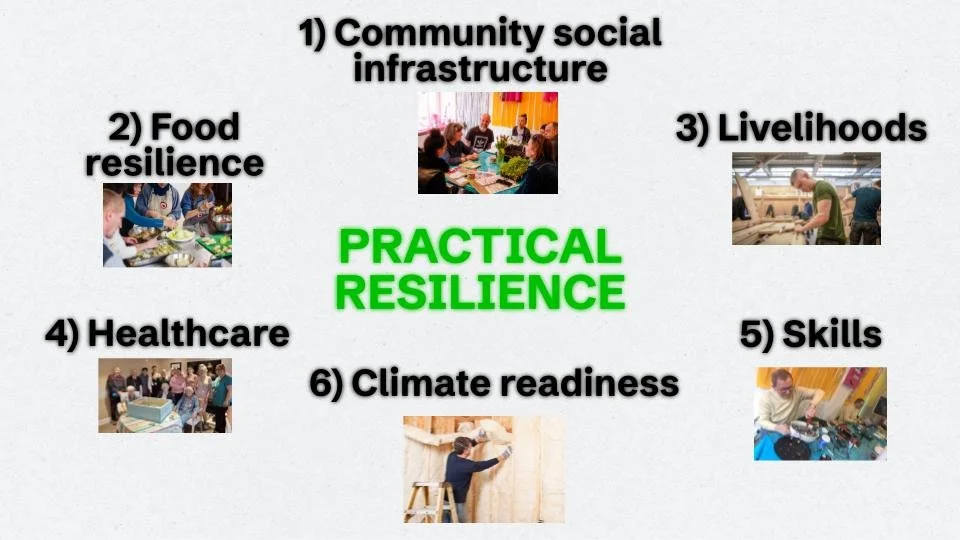
For this shift, choose one of the practical resilience actions below to try this month.
Small steps, practised consistently, can change how we experience both ourselves and the world.
Social connection
You don't need to transform your whole neighbourhood. Start where you are. Choose one thing that feels possible.
Get to know people near you
Strong communities begin with relationships. Introduce yourself to a neighbour. Stop for a conversation. Check in on someone who lives alone. Join a local group. Spend time in your library, community centre, school or other local spaces. Small interactions build familiarity. Familiarity can grow into trust. And trust is the foundation of a resilient community.
Share more
We don't all need to own everything ourselves. Share tools. Swap clothes. Help with childcare. Cook for someone. Give someone a lift. Lend what you have. Ask for help when you need it too. These small acts create networks of support long before a crisis arrives.
Create reasons to come together
Community doesn't usually happen by accident. Sometimes we need to create the invitation. Organise a meal. Start a gardening group. Arrange a street gathering. Run a clothes swap. Join a repair café. Invite people to share a skill. Keep it simple and low pressure. The aim isn't to create another obligation. It's simply to make it easier for people to connect.
Food resilience - Grow, cook and eat more locally.
Food is one of the simplest ways to strengthen community. Cook with seasonal ingredients. Grow something—even if it's just herbs on a windowsill. Join an allotment or community garden. Support local farms and food producers. Try a local veg box. Learn how to preserve food. Cook and eat with other people. The more food knowledge, skills and connections we have locally, the more resilient our communities become.
Health - Build a culture of care
For most of human history, care happened largely within families and communities. We checked on older people. Looked after children. Shared knowledge about health. Noticed when someone was struggling. Professional services remain incredibly important. But communities can also play a bigger role in everyday care. Learn basic first aid. Look after your health where you can. Check in on vulnerable neighbours. Offer practical help. Create relationships across generations. Caring for one another is community resilience in action.
Skills - Learn something useful
Resilient communities contain lots of different skills—and people willing to share them. Learn first aid. Grow some food. Repair clothes. Fix something in your home. Learn to cook with basic ingredients. Practise conflict resolution. Understand how to organise people around a local issue. You don't need to know everything. The real strength comes from different people knowing different things—and knowing each other.
Prepare your home and neighbourhood for a changing climate
Our climate is already changing. Think about how your home and local area cope with heat, cold, heavy rain and flooding. Check your local flood risk. Improve insulation and ventilation where you can. Plant and protect trees. Replace unnecessary paving with plants. Support local green spaces. Get involved in decisions about how your neighbourhood develops. No household can prepare for everything. But together we can make the places we live safer and more adaptable.