


Transformations through workshops, training, daily practices, lessons from experience, better understanding.
WHAT IS THIS PROGRAM?
Our world today begs some big questions. What is the focus for life if not accumulating stuff and wealth? What are the things that really matter? How can we cultivate those things within ourselves? How do we relate to those strong feelings and habits within us that encourage us to keep consuming in a way which is devastating the planet? Are there practices, such as contemplations, rituals or meditations that will help us break those habits? What “system” of thought can we replace the system we’ve been used to all these years?
Take the Jump aims to provide some suggestions and support in answering these questions, and ultimately providing us with the inner tools to help us break our habits and start to live and feel differently.
Inner Climate Mondays: a weekly, rolling online workshop.
New Take the Jump shifts around resilience
Resources: Resources and tools we can use in our own lives
INNER CLIMATE MONDAYS
What are Inner Climate Mondays?
At Take the Jump, we believe that tackling the climate crisis isn't just about changing what we do, but also about understanding what we feel. The state of the world directly shapes our inner world, and learning to navigate this is a vital part of the transition.
That’s why we created Inner Climate Mondays—a weekly, rolling online workshop. It’s a dedicated 90-minute space to pause, connect, and explore the emotional, spiritual, and cultural impacts of the times we live in.
Each week, we gather to share the load. Using different perspectives and practical tools, we create a supportive community where feelings of anxiety, grief, anger, or overwhelm are not just welcome, but are the very starting point of our conversation.
This space is for you if:
You feel the weight of the climate crisis and want to process it with others.
You're seeking a space to move beyond facts and figures to explore the emotional heart of the issue.
You want to understand your feelings—from grief to hope—and learn how to channel them into meaningful action.
No need to book. Just turn up and find clarity, connection, and strength in a community that feels as deeply as you do.
When: Monday evenings for up to 90 minutes from 7.00pm (UK time)
Where: https://us06web.zoom.us/j/88100256642?pwd=VQSpUhMmHZMZmCHCuERaSDyiClxpYV.1
What: From October to Christmas 2026 we will focus week by week on a theme from the new shift Stay Grounded
5 October. Session 1: Introduction & Do Nice Things
12 October. Session 2: Keep a Perspective
19 October. Session 3: Practise Gratitude
26 October. Session 4: Set Rhythms
2 November. Session 5: Set Boundaries
9 November. Session 6: Build Connection
16 November. Session 7: Explore our Shadow
23 November. Session 8: Nurture Presence
30 November. Session 9: Active Hope
7 December. Session 10: Being with What Is
14 December. Session 11: Feel it to Heal it & round-up
Each week stands alone but together they create a powerful set of practices to build inner resilience.
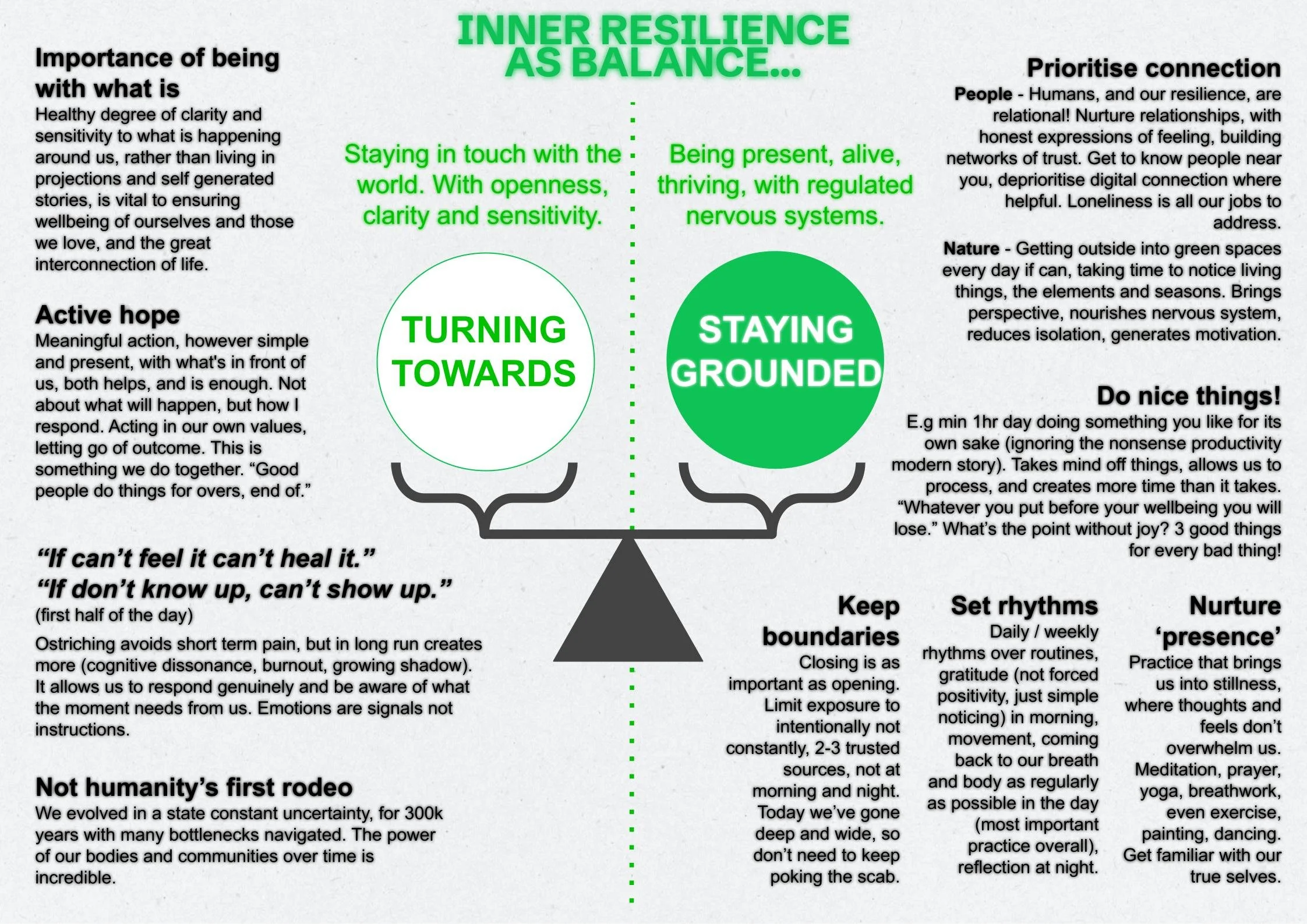
NEW Take the Jump shift: Inner resilience
Take the Jump is working on two new shifts to reflect the fact that in our changing world, building resilience is no longer an option. One shift will be on ‘Practical Resilience’, and one on ‘Inner Resilience’. Here’s a snapshot of what’s being developed. More to follow soon!
INNER CLIMATE RESOURCE LIBRARY
Here is a list of resources, books, apps, and thinkers to support us on our journey.
Books - Adults
Joanna Macy books - including World as Lover, World as Self A deeper dive into the Buddhist philosophy and systems theory that underpins Joanna’s work. Coming Back to Life describes The Work that Reconnects for facilitators. Active Hope A primer on the ideas of the Work that Reconnects
Thich Nhat Hahn - Zen and the art of saving the planet Facing the climate crisis with mindfulness and compassion (see also the course link below)
Paul Levy - Wetiko: Healing the mind virus that plagues our world. See blog ‘Wetiko in a nutshell’ listed below for an introduction
Rob Hopkins - Unleashing the Power of Imagination to create the future we want
Connirae Andreas - Coming to Wholeness ‘is based on the spiritual teaching about awakening - but goes farther to offer a method that’s specific, precise and universally accessible. You don’t need to have spiritual interest or beliefs to benefit.’
Gabor Mate - The Myth of Normal ‘Mate connects the dots between the maladies of individuals and the declining soundness of society, and offers a compassionate guide for health and healing.’
Dougald Hine - At Work In The Ruins. Finding our place in the time of science, climate change, pandemics and all the other emergencies - ‘Through our over-reliance on the single lens of science, Dougald writes that we are blinded to the nature of the crises around and ahead of us, leading to ‘solutions’ that can only make things worse…He offers guidance…to ultimately, help us find the work that is worth doing, even in the ruins.’
Vanessa Machado-de-Oliveira Hospicing Modernity: Parting with harmful ways of living - ‘This book is not easy; it contains no quick-fix plan for a better, brighter tomorrow, and gives no ready-made answers. Instead [we are challenged] to grow up, step up, and show up for ourselves, our communities, and the living earth, and to interrupt the modern behaviour patterns that are killing this planet.’
Robin Wall Kimmerer - Braiding Sweetgrass - An exploration of mutual care and balance drawn from traditional indigenous wisdom, the plant-world and western science.
Ken McLeod - Wake up to your life - A guide to basic Buddhist philosophy and practice focuses on attention, demonstrating how to incorporate this important principle into daily living.
Fazlun Khalid - Signs on the Earth. Islam, Modernity and the Climate Crisis - reconsiders prevailing models of ‘development’ and instead draws inspiration from the realm of the sacred. One of the world’s leading Muslim environmentalists.
Glenn Albrecht - Earth Emotions - You can also find talks and interviews on the web by Glenn. Glenn coined the word “solastalgia” to refer to the pain we experience when places that we love are harmed or threatened.
Gaylon Ferguson - Natural Bravery: Fear and Fearlessness as a Direct Path of Awakening - ‘Offers wise and pointed teachings for helping us to look at fear with immediacy and courage, and to engage with it as a path to transform ourselves.’
Books - Children
Pari Thomson. Greenwild - The World Behind the Door (8 years and above)
Joseph Coelho A Year of Nature Poems (8 years and above)
Earthwise: Environmental crafts and activities with young children
Jane Goodall - Pangolina
Christopher Lloyd and Mark Ruffle - Humanimal - Incredible ways animals are just like us!
Christopher Lloyd - It’s Up to Us. A children’s Terra Carta for nature, people and planet
Courses
Mindful Self-Compassion course (8 week course) https://mindfulselfcompassionuk.com/
www.activehope.infoFree course on website based on the work of Joanna Macy
https://plumvillage.org/courses/zen-and-the-art-of-saving-the-planet ‘A number of us have taken this course. Most of us describe it as “life changing “. Highest recommendation.’
Videos
Imagination: A Way to Remake the World - Iain McGilchrist & Phoebe Tickell (youtube.com)This discussion is 100 minutes long. It is a wide-ranging deep-dive into the role of imagination and intuition in freeing us from the paradigms of unfettered rational thinking and its emphasis on power.
Integrating Ancient Wisdom & Modern Science to Create a Meaningful Life - Jeremy Lent (youtube.com)Amazing zoom through the thinking of Jeremy Lent. Lots of ideas to explore.
https://www.youtube.com/watch?v=ZBV9-YdxX0M Seeing Wetiko - 4 minute introduction to the idea of the mind virus that plagues us
https://youtu.be/l7TONauJGfc?si=YlODLAXmETJ6Hrl- Marshall Rosenberg - Nonviolent Communication - a way of communicating in which mutual needs are recognised and met through understanding and compromise
New Economies: How Degrowth Will Save the World with Jason Hickel (youtube.com)
https://emergencemagazine.org/film/earthrise/?utm_source=Emergence+Magazine&utm_campaign=46a3f47dee-Emergence%E2%80%9420240611&utm_medium=email&utm_term=0_73186f6259-46a3f47dee-357341744 Beautiful short film on the beauty, awe and grandeur of the earth from the astronauts of Apollo 8
https://www.youtube.com/watch?v=aBcRzQ3epcs On Earth Day 2022 a group of local photographers launched an exhibition called Earth Emotions. We had a physical exhibition in a local gallery. Here is a video of the exhibition
Organisations or communities in this space
Inner Development Goals (aimed at leaders of organisations) Inner Development Goals – Inner Growth for Outer Change
Moral ImaginationsPhoebe Tickell’s website. Workshops.
Apps
Headspace A good app for anyone who is new to meditation and mindfulness. Limited free content and then paid.
Plum Village Zen Meditation app
Sounds True An easy way to access much of the material on the website (see below).
Smiling Mind Australian app with meditation programmes from age 3+ to adult
Insight Timer - A great free meditation app with extensive free material
Binaural Beats- BrainwavesCan use a variety of sounds (e.g. stream, birds, windchimes) to create your own meditation mix
Podcasts and recordings
Awakening from the Meaning Crisis - YouTubeProf John Verveke: This foundational series unravels the meaning crisis: the loss of spiritual vitality, and the sense of disconnection we experience with other people, ourselves, and the world at large:
https://podcasts.apple.com/gb/podcast/for-the-wild/id942809988 For the Wild podcast is an anthology of storytelling rooted in a paradigm shift away from human supremacy, endless growth and consumerism.
https://podcasts.apple.com/gb/podcast/we-are-the-great-turning/id1740825892?i=1000652520557 Joanna Macy in conversation with her student Jessica Serrante. This podcast includes study materials and further links for individual or group exploration.
https://podcasts.apple.com/gb/podcast/the-weekend-university/id1494564673?i=1000571203239 Rupert Spira Podcast “The most profound problems that humanity faces – the despair felt by many people, the conflict experienced between individuals, communities and nations, and the exploitation and degradation of the earth – all stem ultimately from our mistaken notion of the nature of reality."
https://www.samharris.org/podcasts/making-sense-episodes/333-sanity-check-on-climate-change
https://podcasts.apple.com/gb/podcast/holding-the-fire-indigenous-voices-on-the-great-unraveling/id1710638300?i=1000630352913 Indigenous voices from around the world on the related environmental and social crises of our times with Dahr Jamail.
Dharma Seed - Rob Burbea's Dharma TalksThe meditator as revolutionary
Websites
https://mindfulselfcompassionuk.com/Provides a list of teachers, courses and retreats running in the UK and online
Center for Mindful Self-Compassion - (centerformsc.org) International and online courses and resources. Also check out Kristen Neff’s website and Chris Germer’s website (founders of Mindful Self-Compassion)
https://www.soundstrue.com/ This is a very rich resource of mindfulness and wellbeing practices, blogs, podcasts and courses from a wide variety of leaders in their field. Some of it is free, some of it you have to purchase but well worth exploring.
Diggers and Dreamers – Intentional Community in Britain (plus book of same title)
Active Hope Joanna Macy and Chris Johnstone
Work That Reconnects Network Huge resource library. Community.
Centres running retreats and courses (UK)
Plum Village, Lieu dit Le Pey 24240 Thenac France
Gaia House, West Ogwell, Newton Abbot, Devon, TQ12 6EW Gaia House Buddhist Meditation Retreat Centre
Sharpham House, Ashprington, Totnes, Devon, TQ9 7UT www.sharphamtrust.org
Trigonos, Plas Baladeulyn, Nantlle, Caernarfon, Wales, LL54 6BW
Articles and blogs
Papers
Reconnection: Meeting the Climate Crisis Inside Out | The Mindfulness Initiative
Earth4All_Deep_Dive_Jamie_Bristow.pdf (clubofrome.org) ‘The system within: Addressing the inner dimensions of sustainability and systems transformation’
Other thinkers and teachers to explore:
Ellen Emmet - body-work and non-duality
Cynthia Bourgeault - Christian mystic
Peter Fenner - non-duality and the art of awareness
If you think that we have missed something important off this list, please let us know team@takethejump.org
OLD CONTENT:
Jump Tool: Learn and develop
Keep your JUMP practice active and continue to deepen your understanding. As the JUMP grows we’ll use this space to highlight tools, workshops and training to help with your Jump. Also articles, evidence and background information to keep up-to-date. On topics including how to approach making the different shifts, where consumerism comes from, how to avoid advertising, greenhouse gas impact etc.
Jump Tool: Nurture inner transition & mindset shift
Watch this space.
Taking the JUMP begs some big questions. What is the focus for life if not accumulating stuff and wealth? What are the things that really matter? How can we cultivate those things within ourselves? How do we relate to those strong feelings and habits within us that encourage us to keep consuming in a way which is devastating the planet? Are there practices, such as contemplations, rituals or meditations that will help us break those habits? What “system” of thought can we replace the system we’ve been used to all these years?
Take the Jump aims to provide some suggestions and support in answering these questions, and ultimately providing us with the inner tools to help us break our habits and start to live and feel differently.
Double-click to edit...
More soon.
Jump Tool: Expand the jump lifestyle.
Taking the JUMP will impact your lifestyle for the better. You’ll experience new ways of doing things, find new connections and shape new priorities. You may feel inspired to link the 6 shifts to the wider lifestyle shifts with which we aim to improve our lives. For instance other aspects of living with less stuff and more joy, such as work life balance.
More to follow.
Jump Tool: Deepen the 6 shifts
Taking the JUMP and adopting the 6 shifts is the most impactful thing you can do to stop ecological breakdown. For those who want to go even further or have finished the JUMP and are ready for the next step, there are other steps you can take (though from a climate point of view you will have done the biggest things through Taking the Jump).
To develop a deeper understanding of your life locally, globally, environmentally and socially, Doughnut Economics Action Lab (DEAL) has free resources available for you to use. In time, we’ll understand how the DEAL approach can assess the impact of the shifts and broaden them.